Showing posts with label diy. Show all posts

Sunday, March 29, 2026

Smock vest from men's denim shirt

Here's a quick sewing project for converting a long-sleeved denim men's shirt into an oversized smock-style vest or apron with lined pockets.


I started with a long-sleeved denim men's shirt like the one in the photo below. (I forgot to take a "before" photo of my shirt, but mine looked almost identical to the one below.)


To make a pattern for the large patch pockets, I used my husband's Carhartt vest as the prototype. These pockets are large and deep, so there's plenty of room for stashing a phone, or my hands, or whatever else I would like to carry in there.

Husband's vest

I laid my husband's vest out flat on my fabric cutting table. Then I took a sheet of newspaper and laid it over the pocket. Using a pencil, I gently traced around the perimeter of the vest pocket to transfer its shape onto the newspaper, then I cut out that pocket shape. I placed the newspaper pocket over a piece of lightweight scrap cardboard I had in my craft stash and, using a ruler and pencil, I marked a half-inch larger (for the sewing seam allowance) to the size of the newspaper pocket around all the sides, then used the ruler to connect those lines, which are the lines for cutting out the pocket pattern on the cardboard.


Originally I was going to make the pocket pattern using a sheet of thin cutting-board vinyl, similar to the ones shown in the photo below, because it's durable for multiple uses as a pattern guide yet thin enough to be cut to size with scissors, but I couldn't find the sheets today that I know I have in my craft stash somewhere, which I bought years ago for this purpose, so I improvised and used the lightweight cardboard instead. Either way, it creates a pattern piece that can be reused for future projects where I want to have this same type of pocket, and, either way, the pattern is thin enough to store with my other pattern files.

Vinyl cutting-board sheets

There are many DIY tutorials online for how to upcycle shirts (or even jeans!) into a vest. One tutorial that I enjoyed was this one by Broken Ghost DIY on YouTube. The way she cut off the collar in her project is very similar to the technique I used here. I carefully trimmed off the flap portion of the collar of my shirt, leaving the collar band below intact for a sort-of mandarin collar effect.

Next, I carefully cut off the sleeves, cutting outside of the seams where the sleeves were sewn onto the shirt (cutting on the sleeve side of the seams, in other words). The tiny bit of fabric left behind after cutting off the collar and the sleeves will fray in the wash and lend a rustic touch to the edges.


I laid my pocket pattern over one of the sleeves and was gratified to see that there was enough fabric in the upper part of one sleeve to allow me to cut out two pockets. If one sleeve hadn't been big enough to cut out two pockets, I knew I would have been able to use the tops of both sleeves to cut one pocket out of each. But since I was able to cut both pockets out of one sleeve, now I have another whole extra sleeve to use as scrap fabric for another project later.

For the pocket lining, I dug into my fabric stash and selected two pink bandanas just waiting to be needed for something. I think the pink bandana fabric makes a nice accent/contrast to the blue denim. All together, I cut two pocket fronts out of the denim and two pocket linings out of the pink bandana fabric and then pinned the pieces together with right-sides facing.


I sewed the pocket fronts to the linings, leaving an unsewn gap of a few inches at the bottom of each pocket for turning them right-side out.


After sewing, I trimmed the excess fabric at each corner, then turned the pockets right-side out and pressed them smooth with my iron. With the seam allowance pressed to the inside, I topstitched along the bottom edge of each pocket to secure the areas that were previously left unsewn for turning the pockets right-side out.


To position the pockets on the front of the shirt, I laid the shirt flat on my cutting table, with some of the buttons fastened to keep the sides even, and then placed the pockets where I thought they looked good, using my cardboard pocket pattern as a guide to ensure the pockets were level with each other. I pinned them in place and then tried on the vest to see if the pockets were positioned at a comfortable height for my hands. Once I had the pockets pinned exactly where I wanted them, I sewed the pockets in place with my sewing machine, backstitching several times at the beginning/end to reinforce the pocket openings.

A peek inside the pockets

The nice thing about making pockets this way is that there are no raw edges exposed anywhere, because they are all hidden between the pocket fronts and the pocket linings.

And, just like that, my smock vest/apron was done and ready to wear! 


Tuesday, July 2, 2024

Easy, perfect DIY bow

My friend Pam would have loved this. She used to be the hairbow-making queen! 💜


@thejibrizyshow How To Tie The Perfect Bow #bow #tie #nickiminaj #icecream #fyp ♬ original sound - The Jibrizy Show

Saturday, October 30, 2021

BaaBaa Black Sheep Last-Minute Halloween costume

I wanted to make a quick and easy hat to serve as a last-minute costume I could wear while handing out Halloween candy. I remembered having this sweet pattern, Baa Baa by Melissa Mall, and thought it would make a great prop to wear. All I have to do to finish my costume is draw on a black nose, wear a comfy black T-shirt and black leggings, and I'll be set as the best (OK, the ONLY) Black Sheep on my block. 


I deviated from the pattern by making the hat with an open top (messy-bun style), a larger stitch count (to accommodate my big cabesa), and with a bottom band made of HDCs. On the ears I also added an extra increase row and two extra straight rows (for adult sizing). I also worked the body of the hat with the wrong side (inside) facing me, because doing it that way means you don't have to push the textured "bumps" out to the right side of the hat. With the stitch combination used in the pattern, the bumps naturally bump out to the side of the fabric facing away from you as you're working, so doing that part with the wrong side facing you saves you from having to do that extra step to get the texture to show where you want it.


This makes a great last-minute costume hat because it works up quickly. I made this in a single evening with small amounts of Red Heart Super Saver in the Black and Charcoal colorways and a 6mm hook. Baaaaaaaa!

Next Halloween, if I manage to plan ahead a bit further, I'd love to work up a Cookie Monster costume along the lines of one I saw a picture of just this morning by Agnes Hsu of hello, Wonderful. She made this for her son, who is just super adorable. She tells you all about how to make this costume on her blog.

Cookie Monster has always been my favorite Muppet, from way back when I was a child growing up watching "Sesame Street," so I would LOVE to dress up in a Cookie Monster costume. I even crocheted a Cookie Monster hat for Caleb, way back in the day.

OK, I couldn't resist crocheting a quick Cookie Monster character hat based on my Loopy Chemo Cap pattern, just in case I don't have enough time to make an adult size of that amazing Cookie Monster costume above.


I used my Addi Pro 22-needle knitting machine to make the eyeballs, and then added one round of SC for the pupils. Whatcha think? 


Monday, March 15, 2021

Lots-a hanger covers

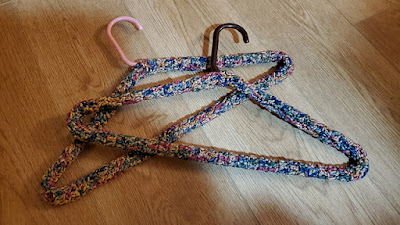
Crocheted or knitted hanger covers are so quick and easy to make and are perfect for making your plastic tubular hangers slip-resistant. These are quick projects that can be great for busting down your yarn stash because they only require small amounts of yarn, and they produce a useful finished object. I mean, who doesn't need a collection of yarn-covered hangers in their closet to keep their nice blouses (etc.) from falling onto the floor? 😊


The crocheted Hanger Cover free pattern by Frugal Knitting Haus is a great, basic option for dressing up your everyday hangers. These look equally great whether worked in solid colors or variegated yarns.

The strip you crochet is six stitches wide (about 2 inches) by about 36 inches long. When you finish off, cut a long tail (about 2.25 times the length of the finished work) and use the tail to sew the cover to the hanger with a wide whip stitch (about 3-4 stitches per inch). No need to be fussy about it because the sewing stitches will blend into and be disguised by the cover. Knot the tails together and hide them inside the work for an easy finish.

Another easy way to make hanger covers is by using a 22-needle knitting machine, such as the Addi Pro.

You can make a matching set of multiple hangers all from one skein of yarn, or you can do like I did above and just grab whatever pieces of yarn you have available for a unique, scrappy hanger.

Using a 22-needle machine, cast on with a few rows of waste yarn. Change to your working yarn and knit 160 to 170 rows to fit most tubular plastic hangers. Leave about a 2-yard tail before cutting the working yarn and drop it into the center. Change to waste yarn and work a few more rows then cast off from the machine. Gently stretch the knitted piece.

Using a 5mm crochet hook, close the end of the tube with the short tail and remove the waste yarn, pulling the short tail through the last loop to secure it. (Don't hide this tail inside yet.) Then close the end of the tube with the long tail, pulling the long tail through the last loop to secure it.

Thread the long yarn tail onto a large needle. Hold the knitted strip so the end wraps around the hanger and whip-stitch the long edges of the knitted piece together. Stretch the knitting until the ends of each side meet just below the hook of the hanger and whip-stitch or mattress-stitch the ends together for a neat appearance. Knot the tails together to secure and then hide the tails inside the knitting for an easy finish. Now your covered hanger is finished and ready to use.

The striped machine-knit hanger cover in the photo above was made with 160 rows, which was just long enough to fit snugly on the hanger. It might have been better if I'd made it 170 rows, which is what I did in the machine-knit hanger cover in the photo below. 


Saturday, February 9, 2019

Economical yarn bowl idea

When your daughter gives you a gigantic ball of yarn, you get to use the BIG mixing bowl.


So here's a DIY idea for how to make an economical yarn bowl using items you might already have on hand. Before starting your project, gather your yarn, a mixing bowl big enough to hold it, and a folding spring clip that has holes in the handles as shown in the photo. Add your yarn to the bowl, attach the clip to the rim of the bowl, and feed your yarn through the holes in the clip handles. Then work your project as usual.

The bowl will help to keep your yarn contained and sitting where you want it as you work. When you run out of yarn, place the next skein or ball into the bowl as before and continue working.

Thursday, June 22, 2017

Fixing the old headphones

When the old foam earpiece covers disintegrate on your husband's old headphones, it's crochet to the rescue! 😁🎧