Saturday, December 11, 2021

A winter vest pour homme

Based on the Improv pattern by Karen Templer, my plan for this is to be a seamless, top-down, cardigan-style vest worked mostly in simple, classic stockinette with K1P1 edging at armholes and button placket/front (worked with the smaller-size needles) and some traditional tortoiseshell buttons. I'm making this for my husband, who needs a replacement for the old aran vest that he reaches for during the chilliest weeks of winter to give him an extra bit of warmth. 


My initial plan was to make this without pockets, but then I realized his original vest has pockets, so I should probably try to add pockets to the new vest by following Marly Bird's tutorial for inset pockets. Another technique that is new to me for this project is picking up stitches along a knitted edge (to add ribbing).
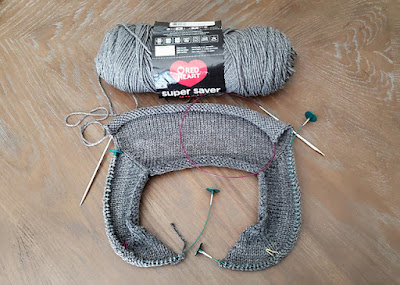

The biggest challenge/question for me, since I'm very slow at hand knitting (and I often have days where I simply cannot knit at all due to chronic pain issues), is whether I'll manage to finish this in time to give it to my husband for Christmas. I cast on for this project on Sept. 21, which gave me about three months to work to meet that goal. Fingers crossed it gets done in time!!! (Spoiler alert: I finished it on Dec. 11! Yay!)


My husband is a person who, even though he supports my enjoyment of knitting/crochet/etc., he has firmly stated right from the beginning his preference that I NOT ever make anything for him because he will refuse to wear it. 


Over time, his declaration has proved to be not entirely true (he has occasionally worn a hat or mitts or a cowl that I've made, sometimes explicitly for him and sometimes not, and he has loved to tatters the blue scarf I knitted for him), but I've always known to generally avoid directing any of my crafting energies toward making items for him.


But when it comes to this vest, I feel like this is a different situation: He has worn the same store-bought knitted vest during winter for decades, and now that THAT vest is wearing out, he's going to need a replacement. I know he prefers neutral, classic design and lines and fit for stuff like this, so I'm attempting to incorporate those values here. I think the trickiest part for me will be achieving the correct fit. As I've worked I've been constantly measuring, checking and rechecking gauge, and comparing size to other items in his wardrobe. Because if this doesn't fit right, I know he won't wear it.


That being said, I've worked out most of this project without using a pattern (other than getting started at the shoulders with Improv), so although I'm familiar with the general principles of garment construction (after decades of sewing/knitting/crochet experience), I'm still nervous to see how the final product for this turns out.


After following the guidelines from Improv for how to begin working a top-down cardigan, I split off stitches to work each of the front panels and the back panel separately, gradually increasing the widths as the lengths grew, then rejoined all the panels below the armhole openings and knit until the bottom of the vest was the right length. I made the armholes slightly oversized, because I knew he wouldn't like to have his arm movement constricted by too-tight armholes.


After rejoining the panels below the armholes, I decided to work the 18 stitches that I cast on below the armholes on each side in garter stitch to give the side panels below the arms a bit of textural differentiation in the torso.


I finished knitting the ribbing at the bottom of the vest the day after Thanksgiving. Two days later, I picked up and knitted the front edging, which extends from side to side behind the neck and includes the buttonholes on the left front. To me it's almost magical the way you can have a curled, gnarled mess of stockinette, but then when you add the edging/ribbing, suddenly the stockinette fabric uncurls and looks gorgeous. I know that's just the way stockinette is (it curls if there's no edge treatment), but it's still fascinating to see it all come together.


Here's the store-bought ye olde aran vest that has served Montie well for many years:


Thursday, December 2, 2021

Ric-rac UGA fan slouchy hat

Made this for our Georgia Bulldog, Jill. I recently saw some designs (such as the ZiggyZag Vixen Slouchy Hat by Faith Holbrook) made with the ric-rac stitch (or cluster V-stitch) and really liked the look (it also looks great worked flat as a blanket, etc.), so I just had to try it

This slouchy hat design lends itself nicely to working with team or school colors. Very quick and easy to make.


I made the pompom removable, so the hat can be safely washed without it.

I also made this quick little coffee cozy for Jill, since she loooves coffee. 


I made this in YOslst, also called HDC slip stitch. 16 stitches tall. 


Apropos feltie came from TheWiredPlanner on Etsy.


Friday, November 19, 2021

Alpine stitch balaclava

At least five years ago, my daughter LadyU asked me to make her a balaclava she could wear while walking the dogs during winter. It took me a long while to finally get around to making it for her, but hopefully she will like it! (There has been a bit of a long saga predating today's project.)


Inspired by the Alpine Ninja balaclava, I used the Crochet with GG video tutorial at this link to learn how to make the alpine stitch in the round (top down), but I worked the top of this hat differently than was shown in the video.

Top part of hat (above the opening for the wearer's face) is worked with a J/6mm hook; bottom part of hat (cowl) is worked with a K/6.5mm hook.

I prefer to work hats top-down, but I don't like patterns where the top stitch count increases so rapidly that the top of the hat curls ferociously until you work far enough down the sides that it helps to tame the curling a bit. That was what was happening on this one when I tried to follow the stitch counts in the video tutorial. So instead I started with 10 sts and made standard increases on that count (next row 20, next row 30, etc.).

My goal was to end up with a total of 72 sts after all the increases, but somehow I ended up with 76 sts on the last increase row; I figured that was close enough (the most important thing was to end up with an even number of sts for the alpine stitch to work). The crown is worked with alternating FPDC and BPDC sts because it's easier to do increases with that combo of sts than it is to try to do increases in the alpine stitch, and I like how the alternating FPDC/BPDC more closely resembles the texture of the alpine stitch at the crown (it looks better than making the crown with all plain DC).

I didn't actually keep count while working the crown, but I think the crown here is 22 rows in purple (the first 6 or 7 rows are alternating FPDC/BPDC increases, then I switched to alpine stitch). If you want to change colors where the balaclava splits to make the face opening, it's important to end the first color on an alpine stitch row where you're working the FPDC/DC sts. The next row is a SC row. I was beginning/ending rounds at the center back. Place stitch markers at each side of the face opening. Then on the SC row,  join your new color and SC to first marker; FSC for however many sts you need to skip to reach the next marker; at the next marker, SC normally to the end of the round. This way when you continue the following row in alpine stitch (FPDC/DC), the color change will look better because the post stitches are reaching across an SC row of the same color (rather than an SC row of a different color).

That's just the way I wanted the color change on this hat to look. It probably could look cool to do the color change over a contrasting SC row as well (so if that's the way you want to do it on your project, go for it!). I also increased the stitch count for the cowl portion to 78 for a bit more ease around the wearer's face.

It only took a few days to complete the crocheted portion of this project. The part that subsequently took months to do was searching for an acceptable pair of buttons to sew onto the folded tab as the last finishing touch. Originally I wanted to use a pair of Pokemon character buttons, but I wasn't able to find any I liked or that would be suitable here. So finally I settled on these washable coconut wood buttons, which I think look nice with the project.

Updated to add a removable 3.5-inch pom:


Wednesday, November 3, 2021

Tag It luggage tag free pattern

We have been using these little tags on our luggage for nearly 10 years now. The tags are soft and pliable, so they won't scratch the bags, and their bright colors definitely help make it easier to pick out which suitcases are ours as they pass by on the luggage carousel!

New tag made in 2021 next to an old tag from 2013

We recently added a new suitcase to our collection, so naturally I pulled out my remnant of Day Glow and whipped up another tag before our next trip.

One of my first tags made in 2013

This is the quick and easy crochet Tag It pattern by Tamara Kelly, aka Moogly, which is available for free on her blog.

One of my first tags made in 2013

As I said, I like to use Red Heart in the Day Glow colorway to make these (the bright colors are so easy to see). If you want to have a contrasting color for the edging, Red Heart in the Glow Worm colorway complements the Day Glow nicely.

If you have to attach these to a large handle on your luggage, I suggest using a 4mm hook and starting with a chain of 35.


Tuesday, November 2, 2021

Cookie Monster costume hat

Cookie Monster is my all-time favorite Muppet, so I wanted to make a messy-bun-style hat of this character. I started mine too late to wear it for Halloween this year, but I'll totally be ready next year!


I used a variation of the Loopy Chemo Cap pattern from my free Chemo Cap Bundle. Instead of starting at the very top of the hat, I started with 40 foundation HDCs (the equivalent of round 4) and then continued to work the pattern as written from there.


I used the Addi Pro 22-needle knitting machine to make the white part of Cookie Monster's eyeballs. My first attempt turned out looking super lumpy and squished, which led me to conclude that the eyes needed a bit of polyfil stuffing to help them hold their round shape.


To make the eyeballs: Cast on with white yarn and knit for 19 rows. Cut a long tail and use a bent-tip needle to cast the stitches off the machine. Gently stretch the knitted piece, and then gently cinch the ends. Fold one end inside the other (same as when you're making a beanie). Pull the yarn tails through the "top" of the cinched ends and knot securely. (This cinched end will be the front of the eyeball; you will later cover this cinched end with a crocheted black pupil.) Thread one tail onto a yarn needle. Grab one handful of polyfil and poke the needle through the center of the polyfil, then slide the polyfil down the yarn tail until it's sitting inside the "cup" of the eyeball. Using the tail on the yarn needle, pick up the bar in the middle of every third stitch along the top of the folded edge (these stitches will be used to cinch closed what is currently the folded end of the eyeball). Gently pull on the yarn tail to cinch the folded end closed, then stitch across the cinched opening to secure. Thread the other yarn tail onto the needle and poke it through the center of the eyeball and out the other side that you just cinched closed. Being careful not to pull too hard and squish/flatten the eyeball, knot the yarn tails together again several times to secure. Leave the long white tails for now so you can use them later to sew the eyeball onto the hat.


Using black yarn, crochet a small "pupil" for each eyeball by working 6 SC into a magic circle. Use the invisible joining technique to finish the outer edge. Tightly cinch the center of each pupil and knot to secure. Leave a long tail to sew each pupil onto the front of each eyeball, centered over the front cinched end. Knot to secure and hide black yarn tails inside the center of the eyeball.


Using the long white yarn tails, attach the eyeballs to the hat and knot several times to secure. Weave in ends and wear your Cookie Monster hat with pride!